

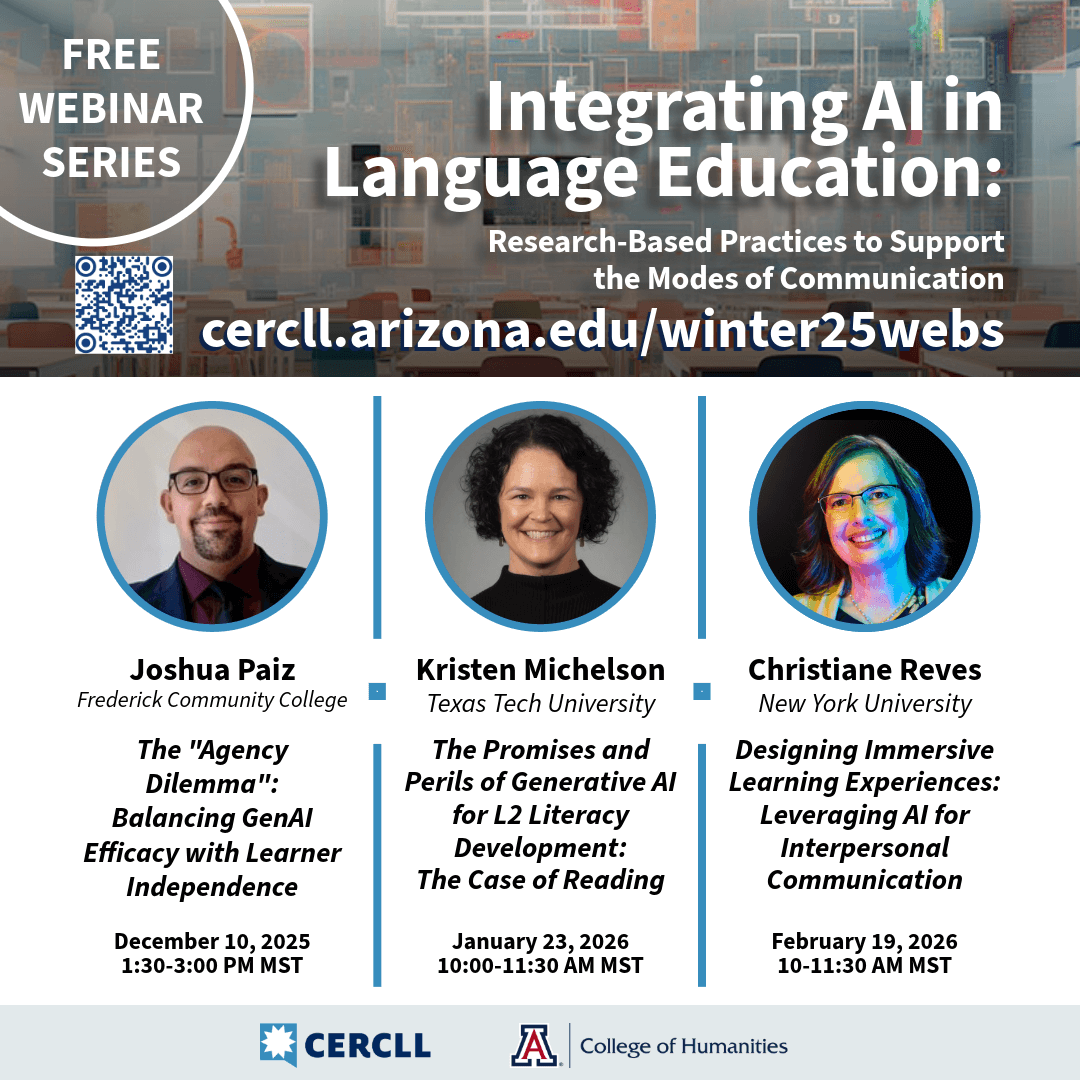
Integrating AI in Language Education: Research-Based Practices to Support the Modes of Communication
Language educators are called on to navigate the rapidly evolving landscape of GenAI in language learning. As GenAI tools become increasingly sophisticated and accessible, educators face both unprecedented opportunities and complex challenges in providing meaningful instruction. Through evidence-based insights, practical strategies, and collaborative dialogue, this webinar series will equip language educators to make informed decisions about leveraging AI tools thoughtfully while keeping themselves and their learners at the center of the language educational journey.
Click on the titles below to access the recordings, slides and resources for the webinars in this series.
You can also view all the recordings in our YouTube webinar playlist!

Joshua Paiz
(Assistant Dean in the School of Technology at Frederick Community College)
The “Agency Dilemma”: Balancing GenAI Efficacy with Learner Independence
While AI tools can boost writing scores, research shows they may diminish student creativity, agency, and independent thinking. Dr. Paiz will guide participants beyond the “use it or not” debate to explore practical strategies that transform GenAI from a crutch into a true collaborator. Learn “human-in-the-loop” frameworks that ensure AI augments—rather than replaces—learners’ critical thinking and personal voice.

Kristen Michelson
(Associate Professor of French & Applied Linguistics in the Department of Classical and Modern Languages and Literatures at Texas Tech University)
The Promises and Perils of Generative AI for Second Language Literacy Development: The Case of Reading
In this webinar, participants will learn:
- Criteria for evaluating L2 reading goals across different pedagogical approaches,
- Techniques for analyzing the usefulness of AI-generated materials for reading instruction, and
- Strategies for guiding learners in using AI to scaffold reading in a foreign language.

Christiane Reves
(Clinical Assistant Professor and Language Program Director in the New York University Department of German)
Designing Immersive Learning Experiences in the Language Classroom: Leveraging AI for Interpersonal Communication
The session reviews how the need for more speaking opportunities led to the development and integration of a proficiency-standards-aligned AI conversation partner into a hybrid course curriculum. It will highlight examples of AI-supported role plays and communicative tasks tailored to different proficiency levels and communicative goals, demonstrating how AI can enhance the use of authentic materials in the classroom environment. In addition, the webinar examines how educators can leverage collaborations with institutional and external partners to secure support and funding for innovative initiatives.
This conversation invites educators to reflect on and explore how generative AI can open new pathways for immersive, communicative, and accessible language learning.
The most beneficial aspect was learning how AI can support the design of communicative language activities while keeping pedagogy at the center.
I will be incorporating the use of AI for worksheet designs and spoken skill practices. Mostly people are hesitant to come forward and express in a classroom but with AI tools and its ethical, professional use in learning settings can assist learners to communicate effectively and according to their required level.
The webinar was very structured and I loved the fact it entailed the Mentimeter questions so people were engaged.