

Sustainability in Language Education: Research-Based Curricula and Practices
Further details and links to view the individual events in the series are below.
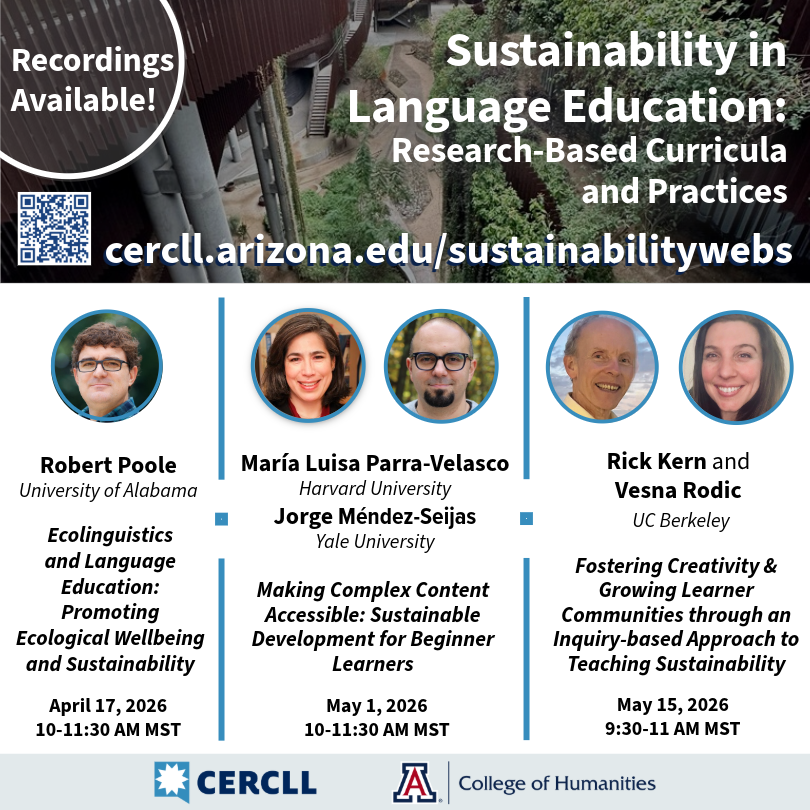
Ecolinguistics and Language Education: Promoting Ecological Wellbeing and Sustainability in the Classroom
Webinar presented by Robert Poole (University of Alabama)
Friday, April 17, 2026
Abstract:
This webinar introduces participants to ecolinguistics and its potential for fostering eco-critical language awareness in the language learning classroom. Participants will learn:
- Core features of the emerging field of ecolinguistics and its potential to contribute to ecological wellbeing and sustainability in the language classroom and beyond
- The principles of eco-critical language awareness and how these aims can inform pedagogy and practice
- To design activities that develop eco-critical language awareness amongst learners in the classroom
Making Complex Content Accessible: Sustainable Development for Beginner Learners
A free webinar presented by María Luisa Parra-Velasco (Harvard University) and Jorge Méndez-Seijas (Yale University)
May, 1, 2026
Abstract:
Fostering Creativity and Growing Learner Communities through an Inquiry-based Approach to Teaching Sustainability
Webinar presented by Rick Kern (University of California at Berkeley) and Vesna Rodic (University of California at Berkeley)
Friday, May 15, 2026
Abstract:
This webinar describes an intermediate-level French curriculum designed to enhance students’ creativity, cultural awareness, and community engagement through inquiry-based activities related to environmental sustainability in French-speaking contexts, as well as within their UC Berkeley campus community. The curriculum incorporates analysis of primary sources (legal documents, literary works, visual images, maps, and films) to study a range of environmental issues, both contemporary and historical. The curriculum has also involved videoconferencing exchanges with students at the Université Aix-Marseille, leading to collaborative recommendations for holding “eco-responsible” events on campus. We have found that, if students are introduced to this disposition of inquiry early on in their studies, they encounter more positive, engaging discipline-specific research experiences in upper-division courses.